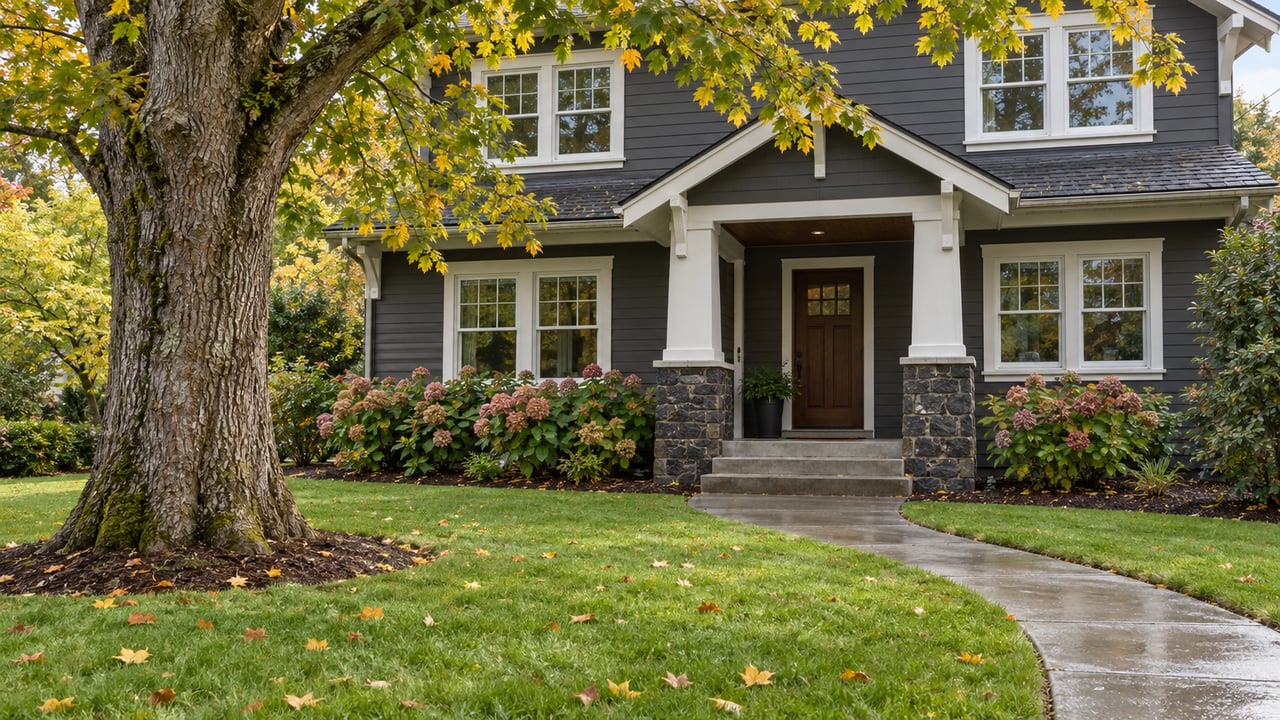
Before a Norkirk bungalow goes on the market, someone usually suggests taking out the big tree that shades the side yard. It does open up the view of the lot. It also starts a clock that the next owner may not be able to stop.
Kirkland's zoning code says the city generally will not accept a development permit for detached dwelling units, middle housing, short plats or subdivisions for 12 months after the most recent removal of a regulated tree, or for 24 months after the most recent removal of a landmark tree. The city states the same rule on its Trees and Urban Forestry page.
That matters more in Norkirk than in most places. Much of what buyers pay for here is the lot itself: the chance to rebuild, add on, or put more than one home where one stands now. A cleared yard looks ready for a builder.
Why the hold matters to buyers
Buyers planning a rebuild, a short plat or middle housing may price in the wait.
Kirkland's middle housing amendments, adopted through Ordinance O-4905 in 2025, address residential density. The city says middle housing stays subject to the tree rules.
An exception in the code
The code gives the Planning and Building Director power to accept an application anyway "in unusual and extraordinary circumstances." That language comes from KZC Chapter 95.
Regulated and landmark trees
A regulated tree is one at least 6 inches in diameter at breast height. A landmark tree is at least 26 inches.
The city's Trees page lists a $600 tree removal permit fee, a $300 landmark tree removal permit fee, each with a 3.5 percent MyBuildingPermit surcharge, and a $305 recording fee for required mitigation trees.
Removals without paperwork cost more
Fines for unauthorized removal or damage are set in Kirkland Municipal Code 1.12.100 and scale with trunk size. The schedule reaches $20,000 per tree for trees over 30 inches, and $30,000 when that tree is protected by an easement or similar instrument. Repeat violations multiply the fine, and restoration costs come on top.
The city has not treated after-the-fact permits as a formality. In an April 2025 hearing examiner decision on a Kingsgate property, the examiner upheld the denial of a retroactive permit for a 30-inch pine and a dogwood that were already gone, because hazard status was not established. The decision says after-the-fact applicants carry the same burden of proof as anyone applying beforehand, and that contractors who took part could be named as responsible parties for future fines.
Trees in development review
During development, applicants must work to keep high-retention-value trees through site-plan changes and arboricultural methods. A tree on a development site can shape where a house goes.
New projects also have to meet a tree density minimum of 50 credits per acre. The code's example shows an 8,500-square-foot lot needing 10 credits.
The paper trail that comes with a lot
Tree obligations can outlast the owner who agreed to them. After development, retained and planted trees fall under a recorded tree maintenance agreement for five years, and successors in interest are responsible for required landscaping. Preserved groves need a legal instrument that protects them in perpetuity. Trees under a voluntary preservation covenant, or trees required by an earlier development's conditions, need a permit to remove even when the ordinary allowance would cover them.
A buyer can look up a lot's history before writing an offer. Kirkland takes all tree removal forms through MyBuildingPermit.com, where a status search lets you pick Kirkland and search by street number, street name or parcel. The city's Property Search map shows permit history by address or parcel. A public records request can be made by address or parcel with a date range and keywords.
Why Norkirk feels this sooner
Norkirk's canopy was already smaller than the city's. The city's 2018 assessment put the neighborhood at 32 percent canopy in 2017, down from 33 percent in 2010. Citywide, the goal is 40 percent. The most recent assessment found about 38 percent in 2021, with the largest share of loss in single-family residential areas. Those 2021 figures are citywide and don't break out Norkirk.
Redevelopment pressure is also reaching the neighborhood. The city's major projects list, revised June 30, 2026, shows Slate Peak at 672 7th Ave in pre-permit review. Its pre-application record, PRE25-00843, describes 30 market-rate townhome condominiums plus 3 affordable units in five three-story buildings. The Daily Journal of Commerce reported in April 2026 that the site could see 33 townhouses. When projects of that size are moving through review nearby, more buyers look at single-family lots and run the redevelopment math.
The rules are also under review. Kirkland is updating its Urban Forest Management Plan, with a City Council briefing on the calendar for Nov. 3, 2026, a Planning Commission session listed for Dec. 10, and another Council briefing set for Jan. 5, 2027. The city's canopy summary names tree code updates among the strategies it may consider. For now, the 12- and 24-month holds are the rules in effect.
This is general information, not legal or financial advice. Tree status, allowances and recorded obligations are specific to each parcel, so confirm yours with the City of Kirkland, a qualified arborist or an attorney before you remove anything or write an offer.
For a Norkirk listing, Marianne Francis handles strategy work quietly and with care. Work With Marianne.